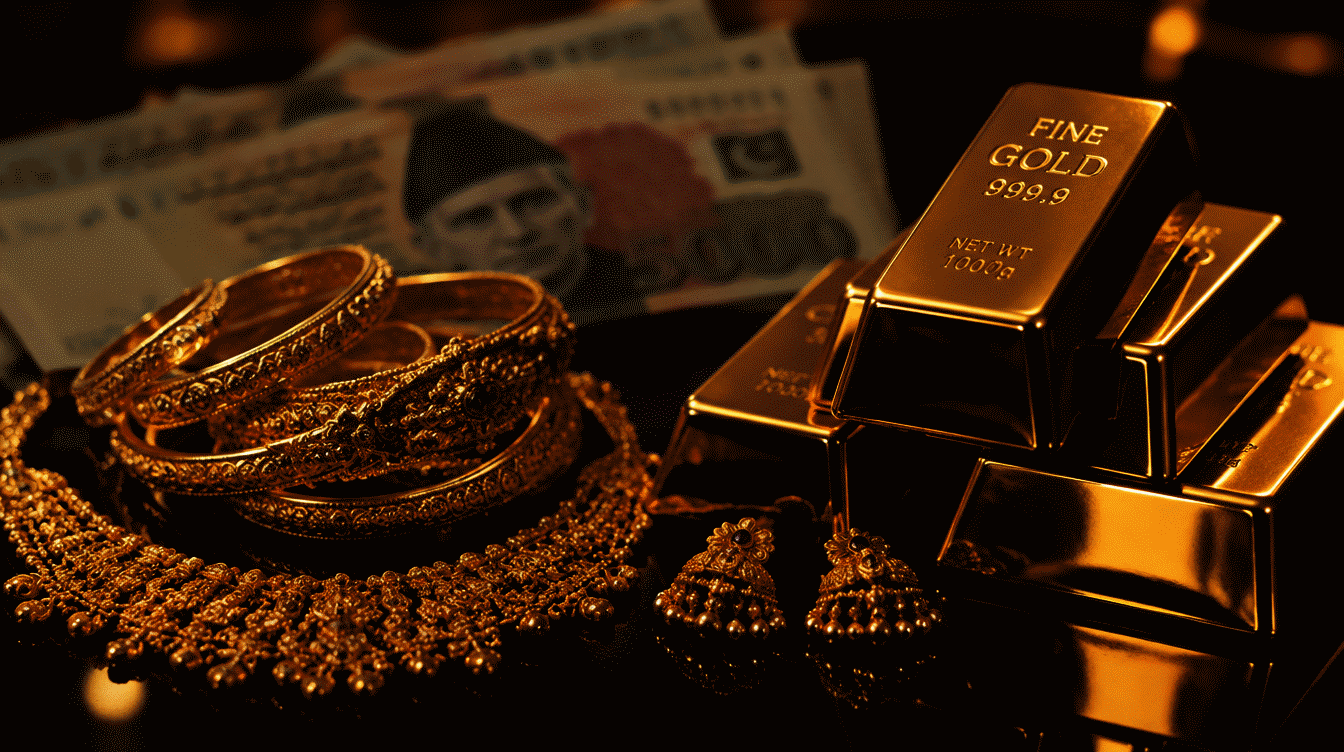
Gold holds a place in Pakistani households that goes beyond jewelry. It is a wedding tradition, a savings instrument, and for many families, the closest thing to a hedge against a depreciating rupee and rising inflation. That makes the daily gold rate one of the most-checked prices in the country - but most people checking it don't actually know what moves the number they're looking at.
What Actually Sets the Daily Rate
The price quoted every morning in Pakistan is not set arbitrarily. It comes from two inputs multiplied together.
The international bullion price. Gold trades globally in US dollars per troy ounce, set on international commodity markets and moving constantly with global demand, US interest rate expectations, and investor sentiment during economic uncertainty. This international price is the base everything else is built on.
The PKR/USD exchange rate. Since gold is priced internationally in dollars, a weaker rupee makes gold more expensive in Pakistan even if the international dollar price hasn't moved at all. This is why gold rates in Pakistan can rise on a day when global gold prices are actually flat or falling - a rupee depreciation alone is enough to push the local price up.
Local associations, most visibly the Karachi Sarafa Association, convert this combination into the daily rate for standard units - most commonly per tola (11.66 grams) and per 10 grams - which jewelers across the country then reference, adjusting for their own margins and making charges.
Purity Actually Changes the Price You Should Expect
A rate quoted for 24K gold is not what you should expect to pay for a piece of jewelry, because jewelry is almost never made from pure 24K gold - it is too soft to hold a shape or stone setting reliably.
- 24K (99.9% pure) - investment-grade bars and coins, the reference rate you see quoted.
- 22K (91.6% pure) - the most common purity for gold jewelry in Pakistan.
- 21K (87.5% pure) and 18K (75% pure) - lower-cost alternatives, more common in lighter or design-heavy pieces.
A quoted "gold rate" almost always refers to 24K. When shopping for jewelry, the actual price should be proportionally lower based on purity, plus making charges on top - and a buyer who doesn't know this distinction is the easiest one to overcharge.
How to Actually Use the Rate Before Buying
Check purity documentation, not just trust the shop. A hallmark or a purity certificate protects you if a dispute ever comes up later, and a legitimate jeweler will have no issue producing one.
Separate the gold cost from making charges. Making charges (labor for design and craftsmanship) are added on top of the gold's raw value and can vary significantly between shops for a similar-looking piece - it's worth asking for this breakdown explicitly rather than accepting one bundled number.
Don't try to time daily fluctuations for a small purchase. Gold rates can move within the same day, but for a single jewelry purchase, chasing an intraday dip rarely saves a meaningful amount relative to the time spent watching prices. Timing matters more for larger investment purchases (bars, coins) than for a single ring or set.
Cross-check against more than one source. Rates can vary slightly between the officially published sarafa association rate and what an individual shop quotes - checking two sources before a significant purchase is a reasonable, low-effort safeguard.
Conclusion
The gold rate you see quoted each morning is the output of two things multiplying together - the global dollar price of gold and the rupee's current value against the dollar - filtered through local purity conventions and shop-level making charges. Understanding that separation is what turns "checking today's rate" from a passive habit into something that actually helps you buy at a fair price.
Frequently Asked Questions
Why does the gold rate in Pakistan sometimes rise even when the international gold price falls?
Because the local price also depends on the PKR/USD exchange rate. A rupee depreciation can push the local rate up even on a day when the international dollar price of gold has gone down.
What's the difference between the per-tola and per-10-gram rate?
Both describe the same 24K gold, just in different units - a tola is 11.66 grams. Jewelers in Pakistan traditionally quote per tola, while international and some modern local sources increasingly quote per gram or per 10 grams; the two should convert to the same underlying value.
Is 22K or 24K gold better to buy?
Neither is objectively "better" - 24K is purer and used mainly for investment bars and coins, while 22K is the standard for wearable jewelry because pure 24K gold is too soft to hold intricate designs or stone settings well.
Do making charges change with the gold rate?
No, making charges are a separate labor cost set by the jeweler and don't automatically move with the daily gold rate, which is exactly why asking for a clear breakdown between gold value and making charges matters.
Is gold a good hedge against inflation in Pakistan?
Gold has historically held value relative to a depreciating rupee over the long term, which is part of why it remains a common savings vehicle here - but like any asset, its price can still be volatile in the short term, and this is general information, not financial advice specific to your situation.